Golf columns · Course strategy & scoring
Planning the Third Shot on a Par 5
Calculate both a trusted wedge distance and a safe advance

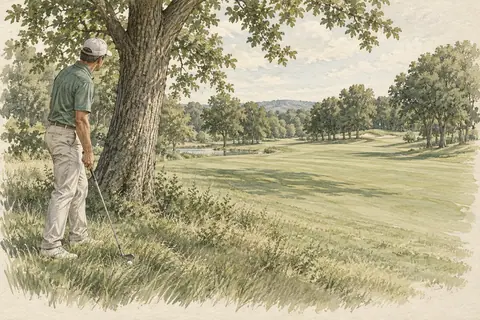
Before the second shot on a par 5, you weigh a wood against leaving a wedge distance. Finding water while trying to reach in two is frustrating, but deliberately staying farther away is not always best when safe progress is available.
The reference is not one favorite number. Consider the next lie, obstacles, and today's dispersion to decide which choice makes the following shot easier.
Subtraction starts the plan
For example, with 230 meters left and a comfortable 80-meter wedge, advancing 150 meters is one plan. These are hypothetical figures. If a bunker sits at 150 meters, correct arithmetic does not make the plan good.
Check landing width and likely run. A club that stops within a safe range may matter more than matching one exact distance.
Distance measurement also has uncertainty. A rangefinder's pin number can differ from distance to the green area where you want to stop. When leaving a wedge, plan around a broad area for the next approach rather than only today's flag position.
Do not immediately call a lay-up a failure because the exact number did not remain. Good fairway lie and an open view preserve important parts of the plan. Practicing distances either side of a favorite shot broadens your choices too.
Assess the closer option as well
If advancing farther brings little penalty risk and a good lie, a closer shot may be advantageous. A preferred distance does not mean you must always stay back.
Shorter distances also deserve comparison
When a long club must carry water or a deep bunker and has a wide miss, a lay-up becomes more valuable. Identify the losses to avoid before choosing the wedge distance to leave, and the choice becomes clearer.
Compare a favorite distance with a closer one
A comfortable 80-meter full wedge is not necessarily better than a 40-meter shot. Where practice space allows, send similar numbers of balls from both and compare grouping and big misses around the target. Check whether the results match your feeling of a favorite distance. These are example distances for comparison, not universal personal values.
Do not consider only the closest ball. See whether a short result reaches trouble or a long one goes over the green. Fewer large misses from closer range may change the value of safe progress on the course. An uncomfortable short distance, on the other hand, becomes a specific practice task.
Separate good grass lies from buried rough. Even at the same 40 meters, grass between face and ball can make reaction harder to predict. If reducing distance increases the chance of rough, compare that with a slightly longer shot from a good lie. A lay-up chooses location and distance together.
Plan the roll after the landing point
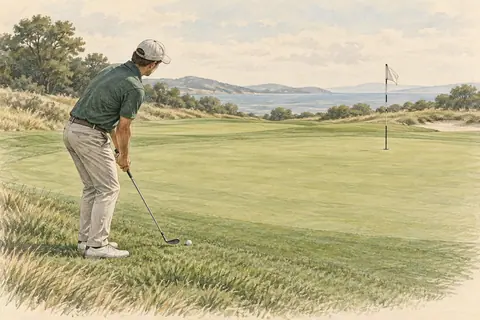
Even when a lay-up club's carry matches the number, a downhill arrival area can produce more run. Check firmness and slopes toward bunkers. Beyond subtracting a club distance from the desired remainder, choose where the ball will actually stop.
When laying up short of water or a bunker, account for the longest well-struck result too. Can you leave enough margin for a ball that goes a little farther than normal? What matters is whether your distance spread fits inside the conservative target, not merely calling the target conservative. Keep the shot intended for safety from reaching the danger.
Do not panic if the third shot is not from the number you wanted. A comfortable lie and open green let you choose again. Treating the lay-up as a process of securing view and footing, rather than a number-matching test, makes a normal next shot easier when the result differs slightly.
Playing a par 5 in three is not simply dividing distance into thirds. It means planning the place for the next shot. Find where today's playable club meets a safe area.