Golf columns · Course strategy & scoring
Four Principles for Uneven Lies
Separate sidehill slopes from uphill and downhill footing
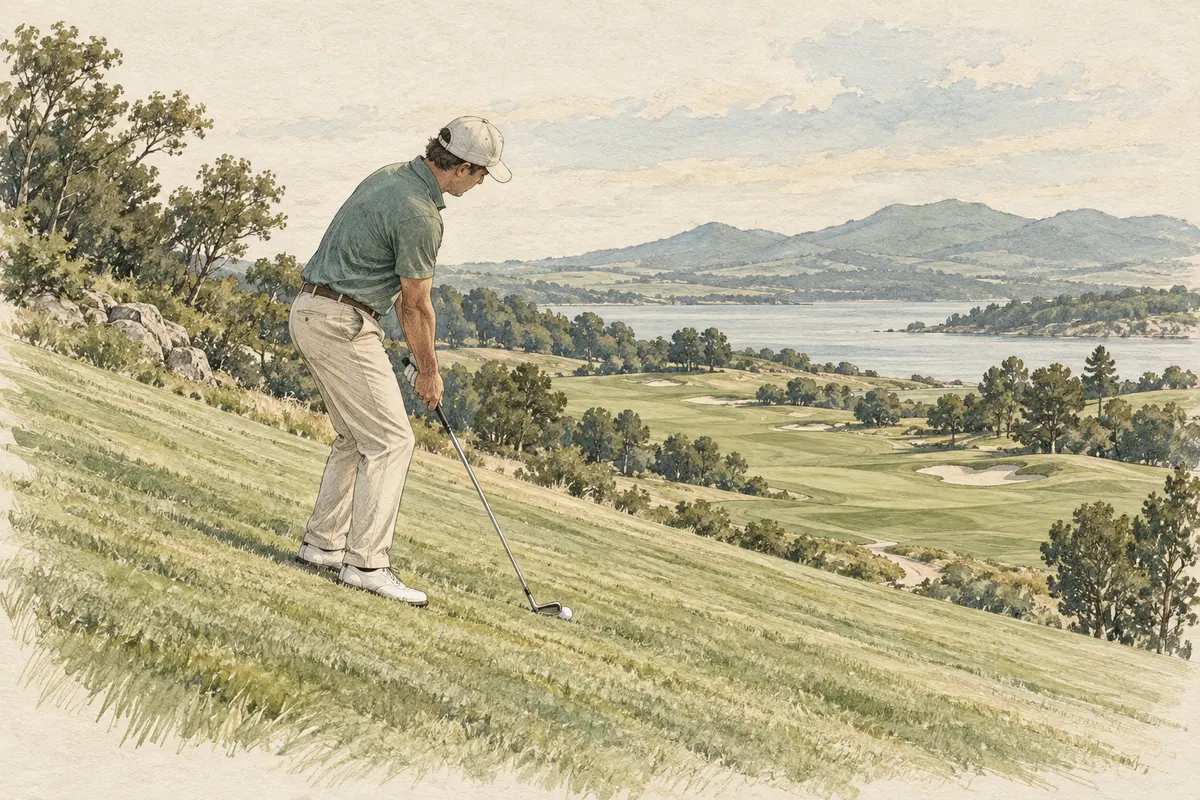
An iron that works on level ground can suddenly behave differently when your footing tilts. On a slope, first find a length that reaches the ball and a swing size that keeps you upright rather than reproducing your full range swing unchanged.
For a right-hander, ball-above-feet and ball-below-feet describe sidehill lies. An uphill or downhill lie describes ground rising or falling toward the target, with the left foot higher or lower. Do not mix these two different axes.
When the ball is above or below your feet
With the ball above your feet, the club feels closer, so gripping down and making a smaller swing creates room. A leftward curve may occur, but it varies with face and swing. Avoid fixed adjustments of a certain number of meters right.
With the ball below your feet, trying to reach can change upper-body height. Bend comfortably through knees and hips and find a stable stance width. Keep the option of a shorter advance rather than chasing an unreachable ball through a full swing.
| Lie | First check | Caution |
|---|---|---|
| Ball above feet | Whether to grip down, and balance | Do not treat a tendency to curve left as a fixed rule |
| Ball below feet | Height needed to reach and secure footing | Check whether the upper body rises |
| Uphill lie, left foot higher | Higher flight and carry | Do not assume normal distance |
| Downhill lie, left foot lower | Lower flight and run | Do not stay back trying to lift the ball |
When the target side is higher or lower
On an uphill lie, matching your stance to the ground can add loft and produce a higher ball. Do not choose only by normal distance; consider achievable safe carry. Do not lean so far that you fall backward.
Many lies combine slopes. A ball below the feet on ground rising toward the left foot will not fit one formula. Rather than adding separate adjustments, first check whether you can stand securely and reach the ball's height. As balance becomes harder, a nearby safe target becomes more realistic.
Decisions based on the left foot's height
A downhill lie can produce a lower flight and extra run. Balance with the slope and continue in a small motion toward the target. Staying back to lift the ball can make contact worse.
Set a balance limit before calculating distance
A small movement without a club can speed your decision on a slope. If the footing is slippery or difficult to support, do not calculate distance on the assumption of your usual full swing. First choose a size you can control, then an area that size can reach. If even standing safely is difficult, consider other options under the Rules.
Gripping down above your feet adjusts effective length but does not automatically preserve normal distance. Below your feet, reaching the ball may create extra tension in knees and upper body. Either way, choose a broad target based on reliable contact rather than the highest value of your normal carry.
A high flight from an uphill lie can also become more vulnerable to a headwind. A downhill lie's lower landing and run may lead toward trouble behind. Instead of memorizing a one-club adjustment table, identify what must be carried and where the ball must stop.
On combined slopes, deal with the hardest condition first
Picture a ball below your feet with the ground rising toward the target. You must lower yourself enough to reach while swinging with the ground's direction. Before adding one correction and subtracting another, ask whether balanced contact is possible. If it is, choose the widest landing area; if not, favor an easier next position over reaching the green.
Where slope practice is available, use small swings to discover the difference from level ground. For the first few balls, observe launch height and contact without immediately correcting direction. Then gradually change the target from the same lie. Do not put arbitrary objects under your feet to create an unstable practice station.
One good shot on the course does not establish a fixed shape for that slope. Face and strike may have happened to cancel other effects. A brief note on start direction from similar future lies reveals your tendencies better than a vague formula. Leave extra margin because those tendencies become less reliable on severe slopes.
You need not preserve both normal distance and normal shape on a severe slope. Staying upright and leaving an easier next shot can be enough to protect the hole.