Golf columns · Practice & equipment
Varying Your Driving-Range Routine
Use repeated-club practice and changing-shot practice for different jobs
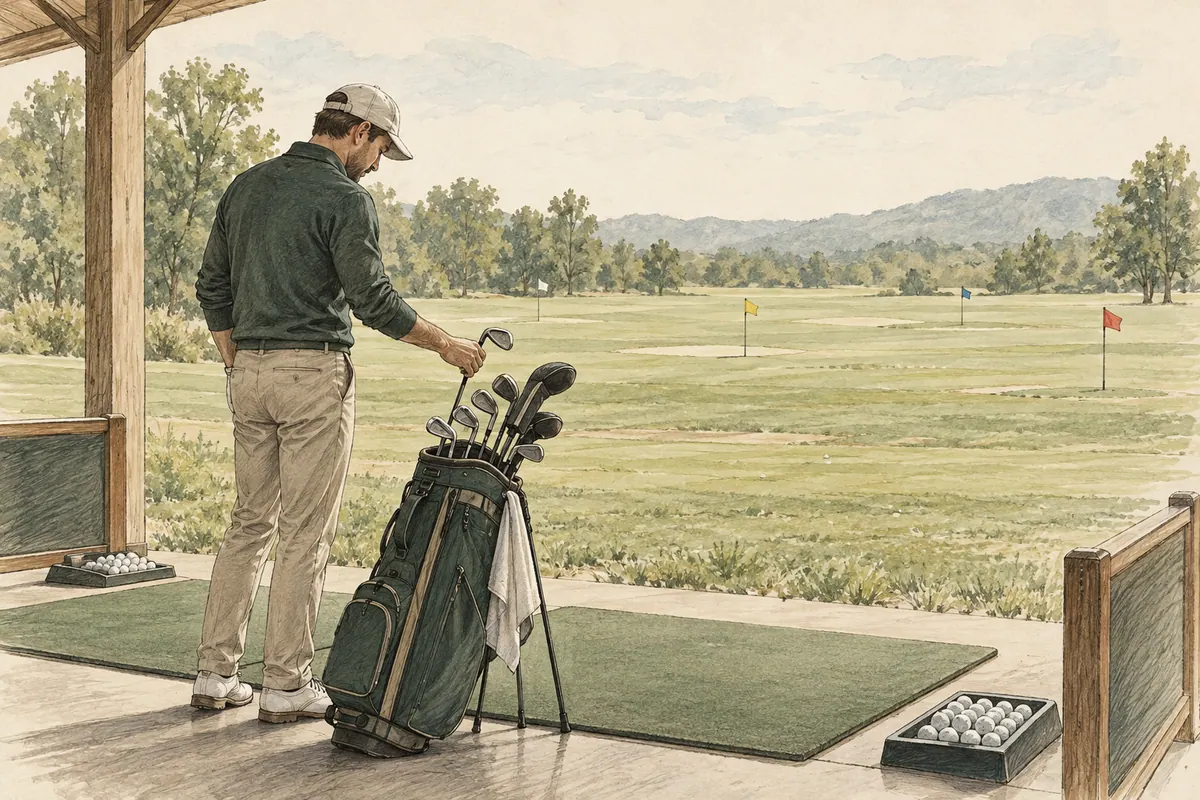
Ten consecutive solid 7-irons on the range can be followed by an unfamiliar-feeling first iron on the course. At the station, the previous ball's feel remains; on the course you walk, choose, change clubs, and have only one attempt.
Repeating one club is not wrong. New movements and contact need time. Just change the latter part of practice so the entire bucket does not end at one distance and target.
Check first, choose later
Warm up and confirm contact with short shots, then practice one technical task for the day. The same club can help compare changes here. There is no need to cycle all clubs so quickly that the changed movement becomes unclear.
Then choose a different target for each ball. Follow a driver with an iron and a wedge to play an imaginary hole. You are practicing mental preparation again during the club change as well.
Keep recording simple during the playing group: inside the target, short, or a wide miss may be enough. Continue preparing a shot and accepting its result rather than analyzing every swing at length.
A brief break between technical and playing practice can help. Decide that the next period is for choosing and executing, not changing positions. That distinction may reduce the habit of returning immediately to correction after a single miss.
Let a mishit lead into the next decision
If the first tee shot went right in your imaginary hole, choose the next club for a rough escape. A range cannot reproduce the actual rough, but the decision can still be practiced.
Repeating the same shot indefinitely because it was poor turns playing practice back into repetition. Note the result briefly and move to the next situation. Inspect technical problems separately in the next technical session.
Divide a 30-minute session by purpose
Imagine a 30-minute practice. Begin by warming up and checking contact with short shots, then inspect one technical task with the same club, and finish by changing target and club while preparing one ball at a time. Adjust the length of each phase to condition. This is an example, not a timetable for every golfer.
During the technical phase, decide what changed and which result to check. If strike is the task, do not simultaneously demand maximum distance. If transition rhythm is the focus, begin with a size that produces contact. Leave time to observe whether a change repeats under the same conditions rather than simply consuming balls.
Change the purpose when entering the playing phase. Stop continually modifying positions; choose a target and enter the routine. Progress to the prepared next situation even after a poor result. Distinguishing the two modes lets technical checks and course execution serve separate roles without interrupting one another.
Imaginary holes reveal gaps in decisions
Hit the first ball as a drive, then choose the next club from its result. A broad-area finish may call for a middle iron; a wide miss may call for a short escape club. Even without perfectly reproducing grass and slopes, you can practice deciding from the resulting situation.
Give the imaginary green boundaries too. Instead of only a center flag, picture an area a short ball fails to reach and a long ball overshoots. After the shot, decide whether it entered that area and where the next ball remains. Refusing to count only the feeling of good contact makes distance and dispersion standards more concrete even at a station.
At the end, note the decision that blocked you most: no alternative to driver, no known swing size for a short distance, or losing the target with a long iron. Start there next time. An imaginary round can be a tool for finding the next task rather than inventing a score.
Extending a run of good contact and preparing one unfamiliar shot are practices with different roles. Using both gives you more opportunity to carry a good range feeling onto the course.